When the Registry asked me to write our story, I was thrilled. I had learned so much by reading about others, I welcomed the opportunity to try and help other families. Surprisingly, writing our story was more difficult than I anticipated. I sat at the computer and thought back to the events of July 2001. It’s amazing how many details I had forgotten about those first few weeks after Tristan was born.
I was working in sales in Tulsa, Oklahoma, focused on taking the corporate world by storm. When I discovered I was pregnant, those aspirations were set aside, and I devoted myself to providing the best possible life for my baby. I enjoyed a comfortable, uncomplicated pregnancy with excellent prenatal care. My doctor ordered the routine blood tests and several ultrasounds, which confirmed my expectations for a healthy baby. The day finally arrived for my baby to enter this world; however, I was completely unprepared when the doctor delivered a stark white baby boy who was not breathing at birth. I remember the complete silence that fell upon the medical staff in the delivery room and the five days of endless tests and diagnosis (and often misdiagnosis) that followed. I am still not sure if it was the shock or the medication, but I remember feeling as if I were in a dream.
When I finally held Tristan, I fell completely and helplessly in love with him. I saw the physical abnormalities, but to me, he was perfect. I was sure the doctors were mistaken and that somehow God was going to fix everything, but after a few days, I could no longer deny the truth. I knew all the tests, pokes to draw blood, and specialists who visited his bedside would not be necessary if Tristan were completely healthy. I hated sitting there, helpless, scared, and frustrated, watching the baby I’d been waiting for my whole life examined like some new scientific discovery. It became clear that my child’s future was not going to be the storybook fantasy I had expected.
The final list of defects revealed by the test results included PDA in his heart, hypospadia, ptosis of the right eye, hearing loss, severe far sightedness, microcephaly, a cleft palate, and dysplasia in his right hip. The NICU doctor informed us that geneticists would need to evaluate my baby boy as was required for any birth with more than three abnormalities.
The fifth day of our hospital stay was the day Tristan was to come home. During the discharge process, we were escorted into a room where we met the solemn faces of the doctors who told us the shattering truth of Tristan’s underlying disorder, chromosome Ring 18. They explained the little they knew of this rare disorder and referred us to information in medical textbooks which included detailed descriptions of the limited life Tristan would experience. Then, perhaps without even realizing the future impact, these doctors offered us the wonderful miracle of hope. They advised me not to believe everything written in those books, and they introduced me to the Chromosome 18 Registry & Research Society web site. I don’t remember much else from the meeting except staring at the table from the web page which stated that 100% of these cases had mental retardation. As frightened as I was by the diagnosis, I was comforted by the knowledge of the Registry. I realized that if an organization existed that researched and supported chromosome 18 issues, then I was not the only Mom who had suffered this news. Through this organization, I learned much information on the disorder. More importantly, I found hope as I read articles from doctors and parents who stated these disorders were not always as debilitating as the medical reports described.
We began therapy with the Early Intervention Program when Tristan was eight days old. At six months, we moved to Houston, Texas, to be closer to family and to afford Tristan the excellent medical care at Texas Medical Center. It was the best decision we ever made. At first, our weeks were filled with so many doctor appointments (endocrinologist, pediatric orthopedics, audiologist, ophthalmologist, geneticist, cardiologists, urologist, ENT), but we are now down to one or two visits each per year. Tristan has had two surgeries on his hips, another to correct the hypospadia, and then another to insert a set of tubes in his ears. Next year, we face what we hope to be the final surgeries: one to correct the ptosis, and one to remove the pins in his hips. Tristan also needed up to six therapies per week (including speech, play, occupational and physical therapy) until he was three years old in July. He now receives speech and physical therapy in the PPCD program at our local public school where he attends until noon. After school, he rides the bus to his day care where he has made many friends.
Probably the one thing I dread more than the doctor visits are the scheduled evaluations of his mental capacity. Depending on the person testing and the mood Tristan is in, he typically scores developmentally from 5 to 15 months. However, the tests do not begin to show Tristan’s character and determination to overcome the odds against him. Tristan rolled over at 8 months, and following hip surgery, he crawled at 19 months and walked at 27 months. Although he does not speak yet, we have been trying to introduce him to sign language. We celebrated his success when he signed for “more” pizza!
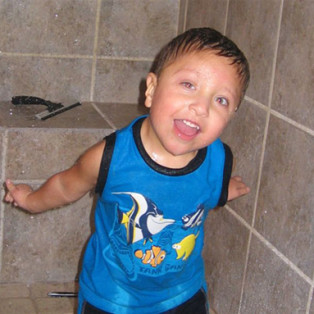
As I recall all the medical details, one fact becomes clear: that is not our story. Our story is of an amazing blue eyed boy who erases all the wrong in my world with one high pitched squeal followed by a big smile. A little boy who statistically should not be able to do so many things; yet, he attacks life with a fearless wonder. When we take him to the lake, Tristan will jump off the boat and splash into the water where he floats without a care. He outsmarts his Mom as he wakes up in the middle of the night, turns on the television, and changes the channel until he finds the cartoons he likes. He has learned to walk twice, both times more than a year sooner than his doctors expected. And although his therapist was wonderful, we all know this feat was accomplished because of the persistent determination that drives him to get up each time he falls. People love Tristan, and Tristan loves people. He gives hugs and smiles freely and has no fear of strangers. Our story is of a precious little boy who loves to eat and can instantly point out any song, scene, or character from the Lion King. Tristan attends play groups, goes to the movies and is in day care with all other three year olds. Without signs or speech, he communicates well with adults and other children.
Ring 18 plays a role in our lives, but it is not the lead. Our lives were not always this way, and there are still days when I feel just as sad and scared as I did the day I learned of his chromosome abnormality. However, the majority of the time, I am so busy shuttling him around from horseback riding or Gymboree, trying to instill some discipline (the downside of Tristan’s determination is that he is also extremely stubborn!), and living in the day to day chaos of raising a child, that his disorder is often an afterthought.
There are a few significant events that helped me overcome my initial grief. The first is that I absolutely adore my little boy. He is so happy and loving, that it is impossible to focus on his disorder or pity him. The second is that I have a wonderful support system. Tristan was blessed to be born into a family where grandparents, uncles, aunts, cousins, and friends completely open their hearts to him. He has four cousins within two years of his age, and even in their youth, they love and protect him. It’s heartening to see how they play together as if all is perfect, but at the same time, they make sure he has a toy, cookie, and anything else they may have.
I was also blessed to have a friend in my life that refused to let me dwell on Tristan’s disability. Through his subtle-and not so subtle- pressure, I’ve learned to allow Tristan to take chances and figure things out on his own. And I’ve been amazed at the results. When left on his own, Tristan’s creativity and problem solving skills eventually prevail over whatever sticky situation he manages to get into. And like all three year olds, there are plenty!
The third blessing is my connection to the Registry. At first I was afraid to get involved because that meant admitting Tristan and I belonged to such a group. Then I met the mother of a beautiful little girl with 18q-. It was such a relief to speak to someone who truly understood what I was going through. After that experience, I followed her example and hosted a 5K Run for Research in my hometown. We had over 60 runners and raised almost $6,000. It felt great to finally take charge and make a difference in this disorder of which I have no control. That feeling intensified as I watched children as young as two circle the track and say they were “running to make Tristan better” or saw my 80 year old grandmother circle the track, exhausted but proud as she acknowledged all Tristan goes through on a daily basis. How amazing that one little boy could inspire so many people!
I was also fortunate for the opportunity to volunteer with the World Congress. It was my first conference and a little overwhelming, but I left San Antonio with a sense of peace I hadn’t realized was missing for three years. Seeing how courageous and strong the adults with these disorders were as they spoke of the success in their lives made me proud that Tristan belonged to such a group. I met parents who inspired me to be patient as they told stories of their children finally learning to speak. Meeting so many happy children and their loving parents reminded me that I am not alone in this struggle. The dedication in that Conference Center gave me the conviction to continue to aid the Registry because I know that somehow, we will triumph over these disorders.
I feel as if each day that Tristan grows, laughs, and learns, I chalk up a victory. Like all new moms, I was full of grand ideas for my baby’s future. I had not decided if he would attend Harvard or Yale, but I did know that he would be happy, loved, and make the world a better place. And here we are, only three years later, and he has already accomplished all three. And with the continued support of my family, friends, and the Registry, it looks like I may get my “happily ever after” storybook ending after all.