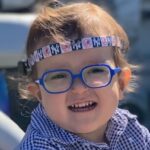
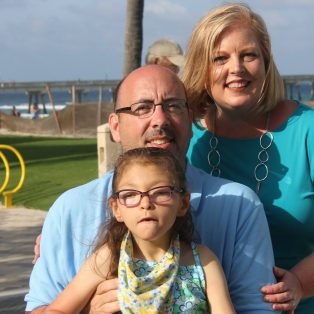
Our daughter Jenna was born on July 8, 2009. She’s got designer genes and a trademark giggle. This is our story.
Because I was of “advanced maternal age” (37), we were offered lots of prenatal tests. We declined all except for the Level II enhanced ultrasound that looks at the baby’s anatomy and can indicate gender. At 18-weeks, we learned that we were having a baby girl and except for an echogenic focus (a small bright spot on the heart); everything looked fine with the baby. Again, we were offered additional testing, but declined after much discussion, because we wanted this baby and we were having this baby!
At 36 weeks gestation, we were getting really excited and talking about how big our girl would be and wondering when she would be born. We hadn’t yet decided on her name. At a routine check-up, we learned that our girl was small and having some trouble. We won’t forget the doctor’s exact words: “Your baby will be better out than in, so we’re scheduling a c-section.” We thought she meant for later in the week, not in 20-minutes! And shortly thereafter, we were a family.
Our girl was born on 07/08/09 at 36.4 weeks and 3-lbs 11.5-oz. After waking from anesthesia, I was brought down to the NICU and saw Dave before I saw Jenna. He had tears in his eyes and he told me how beautiful she was. We looked at our tiny baby and as I counted her fingers and toes (10 each), a nurse adds: “ …and don’t worry about that cleft palate. It can be corrected.”
Our hospital does automatic genetic testing for any baby born with a craniofacial abnormality. While we waited for those results, we learned how to change the smallest diapers we’d ever seen, how to use a Haberman bottle and we were on the fast track to an advanced degree in Neonatal Medicine. Aside from Jenna being born early and small, the most immediate concern at that point seemed to be her tachypnea (fast breathing) and coordinating her ability to suck-swallow-breathe so she could eat safely. We decided to tube feed her to remove the risk of aspiration.
Several days later, we received the results of the FISH genetic test and we learned that Jenna had Ring 18. The two geneticists that talked to us explained that it’s quite rare and they referred us to the Chromosome 18 Registry and Research Society. They gave us a print out from the website that described the condition. We peppered them with questions about what we could expect for Jenna. Will she know who we are? Will she walk? Talk? Laugh? Go to school? Have friends? They told us that every child writes their own story….
I noticed Dave perusing the Chromosome 18 Registry website a few days later. I wasn’t ready. It took a while for me, but, eventually, I asked him what he read and saw. He said he saw pictures of little kids and families. When he showed me a few, I saw smiling, happy faces. I read some of the family stories. I read the section about Ring 18 and its major features. At the time, this information was overwhelming. I just wanted to know if she would be “OK”. I can tell you now, however, that this information proved to be an invaluable tool to help us advocate for Jenna and educate her doctors. Yes, we are educating them! Because we are further along now, I can look at this information and see how Jenna does carry some, not all, of the characteristics. What was once very overwhelming and scary is now part of her just like the fact that she has brown eyes, wavy hair and a gorgeous complexion.
Development is delayed for Jenna but she receives physical, occupational and speech therapy. She sits, rolls, scoots on her bum, uses a dynamic stander at school and a wheelchair to get around. She has been seen by cardiology, although that echogenic focus discovered prenatally turned out to be a non-issue. She has been seen by a pulmonologist for the tachypnea but it turns out, her lungs are just a little small so she breathes faster to compensate. She developed infantile spasms, a form of seizures, which was treated with medication and the Ketogenic Diet. She is currently seizure free. She has a g-tube for feeding and is eating more by mouth. Her cleft palate has been repaired. She has some orthopedic issues and has had hip surgery on both sides. Her growth is slower than her peers and she’s on growth hormone and is doing well. Seemingly unrelated to her ring chromosome, at 5-months old, Jenna was diagnosed with craniosynostosis, where two of her skull plates fused prematurely. This was released endoscopically and she wore a molding helmet for a few months.
Early on, our days were filled with therapy three or four times a week and running from one doctor and specialist to the next. Now, she has her therapy at school and routine pediatric visits. She sees her other specialists for follow-ups only annually or bi-annually. She loves music, being read to and having the wind in her face. She loves being in the water, giving hugs and eating cupcakes. She’s been skiing in an adaptive program and we’re looking into taking her sailing.
It’s now 13-years later, we want to share Jenna’s story. She has an infectious giggle, a dare-devil personality and people are drawn to her. She goes to school and the children in her class adore her. They don’t see her chromosomes and ask why one is different than the rest. They see a friend. We see the greatest gift we’ve ever received.
It’s not easy raising a child with complex medical needs and “designer genes”. We found support and education from The Registry and comfort and friendship from the Chromosome 18 families that walk this road with us.
– Kim and David Stoddard