

There are several different reasons that a healthcare provider might suspect that there is an underlying chromosome change present. Some of the more common reasons include:
- Child missing developmental milestones
- Birth defects
- Health problems
- Minor differences in facial features
- A family history of a chromosome condition
On rare occasions, 18q- may be detected before a baby is born. However, it is usually diagnosed during infancy or childhood. There are two tests that are commonly performed to identify a deletion on 18q. Both of these tests are usually performed on a blood sample.
In this test, white blood cells are grown in the lab. The chromosomes are stained and examined under a microscope by a qualified cytogeneticist. This individual is trained in recognizing extra, missing, and rearranged pieces of chromosomes. Results from a chromosome analysis will tell us the number of chromosomes, whether the person is a male or a female, and which bands of the chromosome are involved in the change. The chromosome result of a person with proximal 18q- might look something like this:
46,XY,del(18)(q21.3)
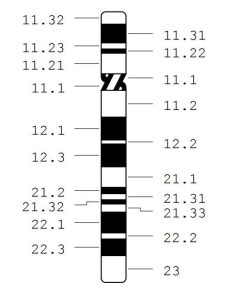
This result tells us that the person is a male and that they have a deletion on one of their copies of chromosome 18. The “q” tells us that the deletion is located on the short arm of the chromosome. The “21.3” tells us that the deletion begins at band 21.3 and extends to the end of the chromosome. The diagram below shows how the bands of chromosome 18 are labeled.
Each of the bands of a chromosome can include 50-100 genes. Therefore, we cannot tell which genes are involved with the deletion from this test result. For a more precise determination of the breakpoint, a different technology is required.
A microarray analysis is similar to a routine chromosome analysis in that it can tell us if there are extra or missing pieces of a chromosome. However, microarrays can detect chromosome deletions and duplications that are too small to be visible under a microscope. Therefore, it is a much more precise test than a routine chromosome analysis. A microarray result can tell us with great specificity which genes are included in the deletion.
Although microarrays are very useful in determining exactly what is missing and what is extra, they cannot determine some other types of chromosome changes. Microarrays cannot detect chromosome changes that do not involve extra or missing chromosome material. For example, they cannot detect certain chromosome rearrangements, such as balanced translocations or inversions. Therefore, both tests may be ordered to fully describe the underlying genetic change.