Hello,
We are John and Marie McGing of Columbia MD. We have 2 children, our daughter Caitlin (1986) and our son Sean (1992), who has tetrasomy 18p.
The story of getting Sean’s diagnosis is a story of how things used to be, Sean being born before the availability of the internet or the Human Genome Project. We had had an amniocentesis, but the results were “an anomaly,” matching anything known. At birth, Sean passed his APGARS with perfect scores but went to the pediatric NICU because he had an elevated heartbeat. A mention of the amnio anomaly resulted in a geneticist from the University of Maryland being called in.
He examined Sean and immediately said there was something here that needed further testing, as Sean had low set ears, close set eyes, a planar crease on the hands and a few other physical characteristics of a genetic anomaly.
Since this was 1992, it took 6 very long weeks to get a definitive diagnosis. Few places in the US could do the needed test and we found later the insurance paid $8,000 to a company in Texas for the genetic analysis.
When we got the diagnosis of tetrasomy 18p, the genetics counselor found very little in the way of explanation. And what was available was sad and dire. In pre-internet times, we looked around and initially linked up with a group focused on Trisomy 18. But somewhere along the line a genetics counselor told us about the Chromosome 18 Registry and Research Society.
We joined immediately and doing so honestly changed our lives. We found a group of people who understood us the way few can, people who were walking the same path we were. And people who were looking to get answers to our questions. And so, this group turned into an extended family.
There are a lot of benefits to being a member of the Registry, but to us it is without question the annual family conference. And it’s not an overstatement to say that the first time you come to one, your life will change. The McGing family (at least one of us, if not all of us) have been at every Family Conference since they started and feel blessed to be part of a large and fantastic group of people who we look forward to seeing every year.
Our family cannot recommend coming to a Conference too much. In 2018 John said the following, which is just true. He said: “I’m sitting here watching where the real work of a Chromosome 18 conference takes place. It’s an ad hoc group of parents, sitting around the table, talking to each other and sharing what they know. It’s the accumulated wisdom being fine-tuned and passed on. And it’s not taking place in the sessions, and while those are good and important, it seems to me that the real value comes in the hallway conversations, the meeting that take place after everything is done and while one parent has the kids in the pool. It’s the forming of relationships, friendships and just finding out that you’re not alone. It’s your kids realizing that their sibling isn’t unique, and neither is their situation, and that there are other brothers and sisters who get it just like they do.”
As “old timers” we have seen the Registry get bigger and the knowledge and research about the syndromes vastly improve and we have been lucky to be a part of that. We have seen the “way things were” story become a more distant history and the Registry is now able to give families such wonderful information on what their diagnosis means; information we could only dream of when Sean was small.
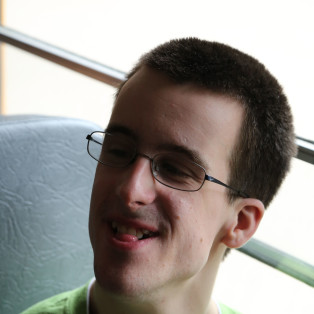
So, what about the guy whose life led us here? What can we say about Sean? In 2019 he’ll be 27, the younger brother of his sister Caitlin, the brother-in-law of Caitlin’s husband Bryan, the cousin of so many. He is a jokester who has many friends, who loves to sing and dance. He has been to Scotland, Canada and Ireland, Chicago and San Antonio and Salt Lake City and Stamford Connecticut. Savannah Georgia, Indianapolis, Las Vegas, Plymouth Massachusetts and Anaheim California. To name just a few.
Sean is a loving soul, tall (5’8”) and thin (118 pounds) who now eats anything and everything. When little, he had trouble eating due to a high arched palate, but a nurse helped us get a feeding study that showed us he could be bottle fed by splitting the nipple with a razor. But he really had issues chewing and swallowing; he was 3 when he ate his first solid food (McDonald’s French fries). Once he figured it out, he took to eating like you wouldn’t believe and eats about everything.
Sean started receiving services as an infant, attended the Howard County Maryland school system from ages 3 to 22 and now is in a post-school day program at the ARC of Howard County. He also attends a specialized class at Howard Community College where he is learning self-direction and computer skills. Sean has always been in special ed, and while he’s been in neighborhood schools, he did much better in specialized programs or schools that could give him what his IEP required.
Sean, like many of those with tetrasomy 18p, has orthopedic issues. At age 3, he had surgery to lengthen and attach his Achilles tendons in both legs. That corrected a very severe problem with his feet (they turned in and he was walking on his ankles), and he has been walking normally once the casts came off.
He has always had a kyphosis (hunchback) and at age 16 he had surgery to fix it. It involved 2 rods from T3 to L4 that corrected his kyphosis and a scoliosis we didn’t know he had. He gained almost 6 inches in height when his back straightened. The downside of that surgery is he can no longer ride horses and swimming got harder.
Sean has always, since birth, had a very slow GI system, and has suffered from chronic constipation his entire life. That is not uncommon among the kids, but that has made toilet training difficult, and in that sense, Sean isn’t technically toilet trained yet.
Sean has a lot to say but has issues verbalizing, his muscle tone issues affect the ones in his mouth and his words are hard to understand. But he loves music and he sings quite well, enough so that his speech is much clearer when singing. He loves contemporary country music but has a diverse set of musical tastes. While his ability to express himself is limited, he has really decent comprehension. He has been diagnosed as autistic (but it is mild) and is intellectually disabled with a low IQ. At age 18 he qualified for Supplemental Security Income (SSI) on that basis.
Sean does Special Olympics (swimming and basketball), he participates in various recreational programs and loves going to the dances to be with the ladies. Sean’s basic instinct is to like people and as such, he makes friends fast.
We are working hard to get Sean to be as self-sufficient as possible, but he will always require adult supervision. While he lives with us now, our goal is to have him live in a group home or similar place where he can be “on his own” yet have the supervision he’ll require to be safe.
Sean’s sister Caitlin has had the opportunity to be the older sister to a special needs brother and the daughter of 2 frazzled parents. It wasn’t always easy for her, but here the Registry helped as well, as meeting other siblings let her find out others knew exactly what she was feeling as regards us and her brother.
She’s earned a Master’s degree and is a guidance counselor in a local elementary school. And now is married.
Looking back, we had to juggle our jobs and do things we never thought we’d do. We were both blessed with an employer with liberal leave and family friendly policies, and bosses who gave us what we needed. We were able to juggle those hectic early years and can attest that things do settle down and life becomes more routine.
It’s been an amazing journey of 27 years for us. And regardless of what the future holds, I’m certain our relationships and connection with the Registry will remain ongoing. We may no longer need the information that the research is providing like we did when Sean was little, but we look forward to seeing all of our old friends every year and meeting new ones.