In the three and a half years that I had been a mother, I think I could count on one hand the number of times I had taken Catherine to the doctor. That naïveté about the medical profession changed forever with the birth of my second daughter, Elizabeth. By the time Elizabeth had her first birthday she had been to over 75 doctor appointments, had two surgeries and was in an early intervention program two half-days a week.
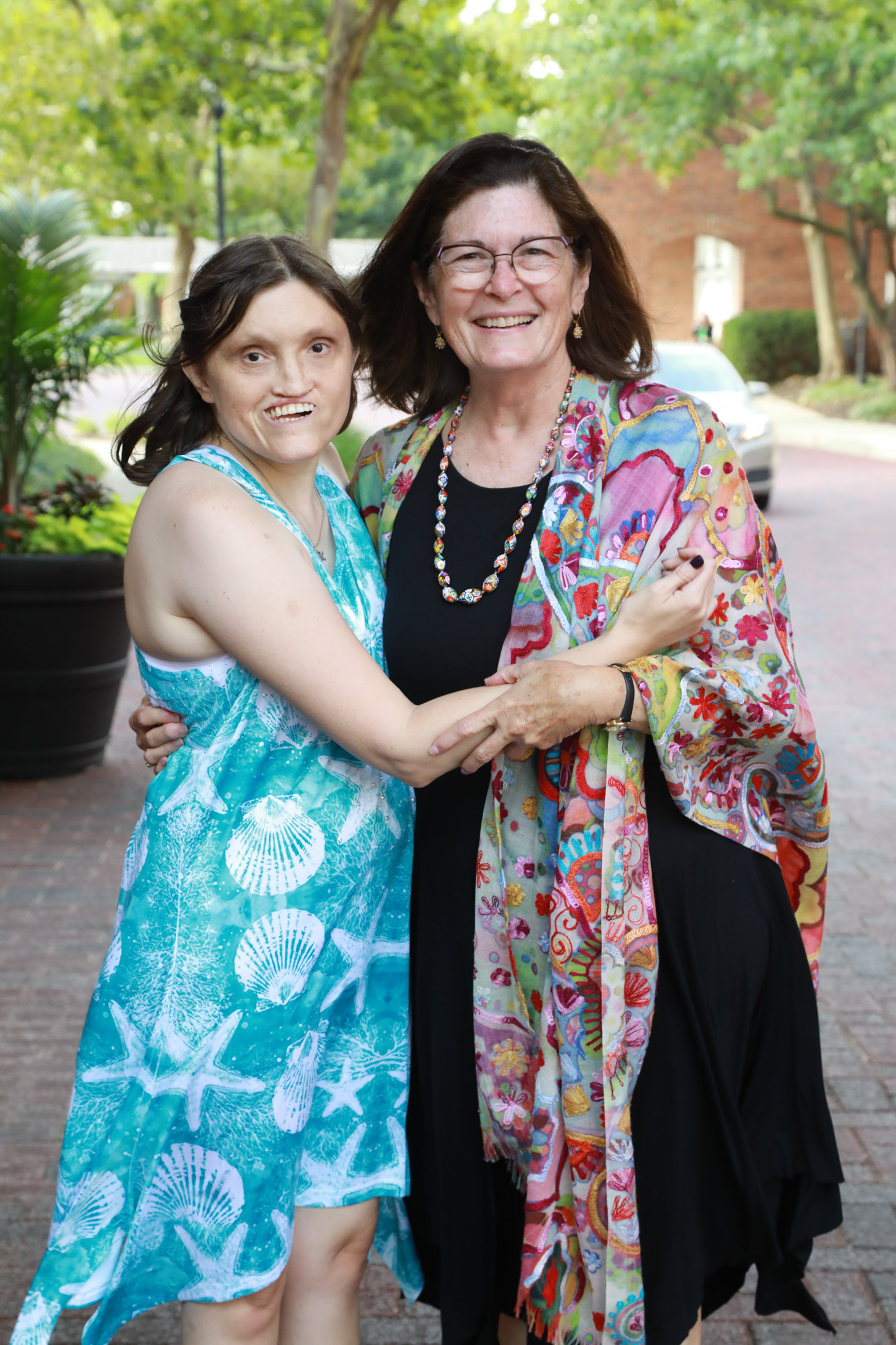
Elizabeth Claire Cody was born on January 11, 1985 with a bilateral cleft palate and cleft lip. This meant that she had no top lip and no roof to her mouth. In addition, her feet curved inward. When we left the hospital a week later, she had provided blood for a chromosome analysis to see if that might shed light onto her medical problems. She had little bitty casts on her feet to try to straighten them and we had made an appointment with a plastic surgeon to make a plan for the surgical repair of her lip and palate. Thank goodness John was in the Air Force. In just over a month we were moving to San Antonio, home to Wilford Hall Medical Center, the Air Force’s largest hospital.
The day before we moved to San Antonio, the pediatrician called to say he had some test results for me to pick up before we left town. By this time, Elizabeth was six weeks old and she seemed to me to be alert and progressing like any normal six week old, so I was completely unprepared for the results. The chromosome test revealed that Elizabeth had a deletion of the end of the long arm of chromosome 18, the 18q- (eighteen q minus) syndrome. The pediatrician had an article copied from a medical textbook that described patients with the 18q- syndrome. The book had scary pictures of strange and contorted babies and listed many horrible sounding medical problems associated with this syndrome. One paragraph summarized the syndrome by saying, “They are probably the most seriously afflicted among carriers of chromosome anomalies. They maintain the frog-like position observed in infants and are reduced to an entirely vegetative and bedridden life.” There are no words to describe the depths to which such words can rock the soul of a parent. Did Elizabeth really have all of these problems? Would she really turn out this way? Had she been born two decades earlier, we would most certainly have been advised to place her in an institution and go on with our lives.
We did go on with our lives, but with Catherine and Elizabeth the center of everything.
When Elizabeth was two years old and not even close to keeping pace with the normal growth curves, we asked her pediatrician to help us find out why. His reply was, “She has 18q- and they’re all short.” In spite of the pediatrician’s reluctance, we were able to determine that Elizabeth was growth hormone deficient. Elizabeth responded remarkably well to the growth hormone replacement therapy and grew at a record pace.
When she was three and had been on growth hormone for about six months, I wrangled a referral to a child neurologist. I did not know exactly what neurologists do, but we had never seen one and you never know who might have new insights for us in our quest to understand this puzzle. The neurologist was Dr. Sid Atkinson, and he ordered an MRI of her brain, an EEG and an ABR. The results for the MRI and EEG came back as normal, but the ABR (Auditory Brainstem Response) was very abnormal. The readout of this test was supposed to show a series of peaks, but instead showed no discernible peaks. Elizabeth was hearing impaired! We had no idea. She had had many sound booth type hearing tests and had done fine. No wonder when she talked, we could not understand what she said. The messages her brain was getting from her ears were garbled, so she spoke garble.
In 1989, a couple of things happened. I met another mom who had a son the same age as Elizabeth who also had 18q-. This was the first person I had ever talked to that had a child with 18q-. After lengthy conversations with her I realized that she had many misconceptions about 18q-. She was getting Trisomy 18 information confused with the 18q- information. I told her about getting her son’s hearing tested and about getting him tested for growth hormone deficiency. Although I felt like I knew virtually nothing about 18q-, she knew less. I knew more, in part because we had access to such excellent medical care. I had learned a lot about what was not wrong with Elizabeth, which is important for a mom who has endless fears about all the things that can go wrong when you really do not know what the diagnosis implies.
I wondered about how I might find other families, families who need to know that they should test their child’s hearing and test them for growth hormone deficiency. There might also be families out there who have learned something important about their child that could be of benefit to Elizabeth. But how do you find other families?? I had absolutely no idea.
The conversations with this other mom really made me appreciate how much growth hormone therapy had helped. Elizabeth’s body was getting some shape. She no longer looked like a frail miniature person. She looked more like the four year old that she was. We had just repeated the ABR to make sure that her auditory nerve problem was not getting worse. Instead it was getting better. A lot better! The audiologist said, “Hum?” The neurotologist said, “We have some maturation here.” The neurologist said, “Oh my God! This is not supposed to happen! Could growth hormone do this!?”
Since this same question had occurred to my husband, my mother, my aunt, and me this consensus sent me to the medical library. I found an article that said that cultured fetal rat brain cells made myelin basic protein when given growth hormone. The gene for myelin basic protein is at the end of 18q and is, therefore, one of the genes that Liz has one copy of instead of the normal two copies. Myelin basic protein is an important part of the myelin sheath in the central nervous system that is important for normal nerve function. Maybe growth hormone could do this?
When I told the neurologist this, I also said we need to find the other families. He said, “Oh! You want to start a support group!” I enthusiastically said, “Yes!” But the reality was that I had no idea what he was talking about. The only thing that the words “support group” brought to my mind was the original Newhart show. Bob Newhart played a psychologist who had a group of crazy patients who sat around in a group and made each other crazier. But Dr. Atkinson seemed to know just what he was talking about. He went to his filing cabinet and pulled out a brochure for the International Rett Syndrome Association. He suggested that I call them to see how they got started.
I did call the Rett Syndrome Association, and I talked at length to Kathy Hunter. I was envisioning that I was talking to her as she sat in her office suite in a high-rise office building. I found out later that I was talking to Kathy in the basement office of her home. Amazingly, as these things often turn out, Kathy was going to be in San Antonio in two weeks for the Child Neurology Meeting, and we made plans to meet. When I did meet her, she was in the company of several leaders of other support groups. I was absolutely blown away by the fact that they were all just moms like me. They started organizations, they traveled to medical meetings, they published newsletters and sponsored national conference for families. This was mind-boggling! This was one of the most exciting days of my life! It WAS possible for “just a mom” to make a difference!
Since I had been active for many years in The Embroiderer’s Guild of America, things like bylaws and tax-exempt status were not entirely new to me. With the guidance of Kathy Hunter and the Alliance of Genetic Support Groups (now the Genetic Alliance), Dr. Atkinson and I began to put together the nucleus of this organization. The Chromosome 18 Registry & Research Society became “official” in 1990. As they say – the rest is history. Since that time, we have found several things from which Elizabeth has had great benefit. When she was in first grade she still did not have meaningful speech. Of course she thought she did, and she seemed to think that all of us were absolute idiots for not understanding her. She was very frustrated. So we finally listened to the school and let them teach her sign. We had not let them do this for years because we feared that if she signed, she would never talk. If she did not speak and only signed, she would be segregated into the deaf community and be unable to deal with the larger society. Well, we could not have been more wrong. Once she had signs to supplement her speech, she spoke more and was understood. Since she was not in a hearing impaired class at the time, her teacher, the aides and of course we, all had to take sign class. Well, Elizabeth picked it up faster than any of the rest of us. So the school decided that she was not so dumb after all, and beginning in second grade, she was a member of the hearing impaired class. This was a huge improvement for her. The curriculum was more academic and stressed language skills very heavily. They all spoke and signed simultaneously, so it really improved her speech.
What did not improve much was her reading. When she was five, she knew all the letters and the sounds they made. But by age thirteen she was still stuck at a first or second grade reading level because she could not sound out words. She could make the sound for every letter, but they never merged into a word for her. This is not too uncommon for deaf children. If you cannot hear it is really difficult to sound-out words. But Elizabeth was not actually deaf and her inability to read was really holding her back in school.
I had read about a program for language-delayed children called FastForword (Scientific Learning Corp.). This was a program based on scientific principles and not just on someone’s pet teaching method. In fact, studies in rats had shown that they actually develop new nerve connections after exposure to experiences similar to that used in FastForword.
There was finally a speech therapist in San Antonio certified to offer this program, so we signed Elizabeth up. It is very expensive in terms of time and money, but some school districts are now starting to pay for it. It is designed on the premise that children who are speech delayed are so because they cannot process sound fast enough. Most of us can distinguish two sounds as two distinct sounds if they are presented 10 milliseconds apart. But people with this processing problem can only hear two sounds as two sounds if they are 80 milliseconds apart. If two sounds are closer together than that, they only hear one of the sounds the other is lost. People with this problem cannot tell you that there are three sounds in the word cat, for example. FastForword is a computer-based program that has seven sound- based games. The games begin with acoustically modified sounds that are lengthened and far apart. As the participant progresses, the sounds get shorter and closer together. The whole program takes two hours per day, five days per week for about six weeks. Elizabeth did this and now she can sound out words, so now she can read!
One other important breakthrough happened at our conference in Colorado. Dr. Randi Hagerman spoke about drug therapy for behavior problems. Since Elizabeth did not have any behavior problems, I did not expect to get anything useful for us from this talk. Wrong again! I learned that antidepressants can help reduce anxiety, and children who are developmentally delayed often talk more when treated. Elizabeth definitely had a lot of anxiety about her speech and often could not speak when she felt put on the spot. In the process of evaluating her behavior with the doctor, we realized that she did have depression. So she started taking Zoloft and she seemed to come alive! She spoke more (nonstop for the first few days) and she started planning and doing projects. Her teachers also saw big improvements.
Elizabeth’s biggest problem continues to be low expectations on the part of all of the rest of us.
For me, the best part about the Registry is the fabulous people I have been privileged enough to get to know. Normally, you really only know those people who live near you and are in your same educational and economic group. But through the Registry I have met people from all backgrounds, from all over the world, who have many different occupations, beliefs and resources. The one thing they all have in common is that they have a vision for a better future for their children and are willing to work for it. It is unbelievably enriching. Thank you all.