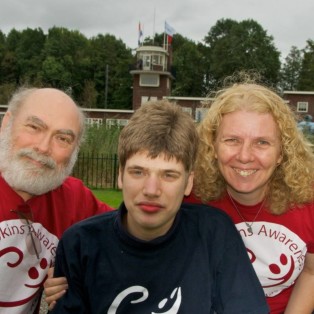
We received Christopher’s diagnosis of Pitt Hopkins Syndrome in October of 2007, weeks before his 16th birthday. We had known Christopher had hypoplasia of the Corpus Callosum from an MRI at 34 months old, but until the phone call to my husband from the geneticist, that was all we had known for years. I was on a course in the UK, and as my phone was switched off, he had to text me! After almost 16 years without a diagnosis, I received Christopher’s diagnosis by text!
Christopher has a mutation of one of his TCF4 alleles on exon 17. He actually has a frameshift mutation resulting in a translational stop codon. He was born by elective cesarean on November 8th 1991 as, like his older and younger brothers, he was breech. Every midwife in the hospital visited him to admire his beautiful silver grey hair. He weighed 3175g (7lb) and, although he often fell asleep when put to the breast, regained his birth weight by a week. He was a very efficient nurser.
The first year was spent worrying about Christopher’s slow development. He didn’t smile till 12 weeks, didn’t roll, reach out, or cry when he woke up. At a year he had to be supported with both arms as he had no trunk control. Nonetheless doctors, both in the UK and in Germany where we were living, told us he was a heavy, lazy baby! At 10 months we were informed by a pediatrician in the UK that we had 2 fine healthy sons and to stop worrying. Two months later we were told Christopher may never walk or talk, we would have to wait and see. We were told he had central hypotonia and psycho-motor delay.
We did intensive home therapy: Christopher learned to roll at 16 months, to balance sit at 2, get to sitting at 2 1⁄2. He learned to crawl when he was 4 years 9 months and did this for a few years until learning to bottom shuffle. He walked at 9 years old. Christopher can get to standing from sitting on a chair very easily and has been pulling to standing for many years. He has recently been able to get to standing from sitting on the floor by pushing himself up on low furniture. It’s usually to go out to the kitchen to see if his food is ready but just recently he has gotten off the floor (where he often sits so he can scoot nearer to the television when it’s on) to sit himself in a comfy chair! He is now climbing stairs quite confidently and descending with help but he doesn’t initiate this alone very often.
 Christopher is nonverbal but has been known to say words. Once at school in the UK, aged almost 10, he repeated different words spoken to him. 2 days later he answered a question but other than a few times when we, and others, have heard him say banana (his favorite food) he has remained non verbal. He can be very vocal sometimes and it’s lovely to hear his voice. We wish we knew the key! We wish we knew what came together those days that let him get some words out. We do know now that he has, at least on a few occasions, had the ability to hear a word and then coordinate his tongue, mouth, lips, and vocal chords to reproduce it. He is a very friendly young man and will seek out other people. He greets everyone he knows with a broad smile and if they are very special, in his eyes, with a nose rub.
Christopher was born in the UK as I knew I would need a cesarean but we lived in Munich, Germany until he was almost 6. We then lived in the UK for 5 1/2 years and have been in the Netherlands since. He was at school in the Netherlands when he was diagnosed. We have often wondered if he would have received his diagnosis so early if we’d not moved so close to the LUMC (Leiden University Medical Centre ) which was part of a research project into Pitt Hopkins Syndrome. We were told that there were only 16 children molecularly diagnosed and reported in the world at the time.
Our geneticist put us in touch with 2 other families in the Netherlands and later we together founded the Stitching Pitt Hopkins Syndrome. This was the first charity for Pitt Hopkins Syndrome in the world. Twan, the young son of one of the families, was the first to ever receive a molecular diagnosis of PTHS. All previous cases had been clinically diagnosed. In fact between 1978 and 2007 there were only 7 to 8 documented cases.
Before we knew there were so few diagnosed we had searched for a support group via Contact A family in the UK and told there was none. I was advised to put messages on a UK site that Contact A Family runs called “ Making Contact” and also on the Inspire site in the States. I heard back from one family within days and we discussed starting a support group when there were 3 of us. We heard from no one from November until the following March when I heard from Theresa and we decided to set up the Google support group.
About 3 months later we were contacted by a mother in the UK who had had a phone call from her geneticist’s secretary telling her that her son had “something wrong with his TCF4”. She was expected to wait a few months to find out what that meant. She wrote and asked “was TCF4 connected to any other syndrome?” I didn’t think it was but started to search the internet and came across the The Chromosome 18 Registry & Research Society. I had never thought of searching for information about Chromosome 18 itself and wondered why I hadn’t before that evening! I found a letter telling about research into children with 18q- and a phone number for further inquiries. As I knew TCF4 was on 18q I decided to call as although it was late evening in Europe it was still the afternoon in San Antonio! I found myself talking to Dr Jannine Cody and we talked for about half an hour about the PTHS support group and the chance for those children that had deletions of their TCF4 to be able to take part in the research. I had my question answered for the new mother and an offer from Jannine to help the support group with any advice. She also offered the opportunity for a break out group for PTHS in conferences, should we be able to attend. I then emailed Jannine with more details of Christopher for the future. I also sent photos of some of the other children with PTHS that we had met a few weeks before that I had been given permission to share. Jannine wrote back to me that weekend and said the photos had reminded her of some of the children with 18q-, including the TCF4 missing too, and that this was one of 50 genes that were often missing with these children, she wrote “the ‘big picture’ path that we are on is to figure out the key genes and then figure out what to do about it. So if this is a key gene, then we next have to think about how to upregulate it. ????? Lots to do and lots to learn!”
We joined the Registry and hoped one day we would be able to attend a conference. Then we found out that Chromosome 18 Europe was being formed. We have been able to attend all three of the conferences in Glasgow, Milan, and Manchester and we are looking forward to the next one in 2016! Nearly every talk we attended was relevant to our children in some way. I’d certainly encourage any family with PTHS to attend a conference if they can. In Manchester last year the committee very kindly allowed us to piggyback the Chromosome 18 conference with our Pitt Hopkins UK Day.