
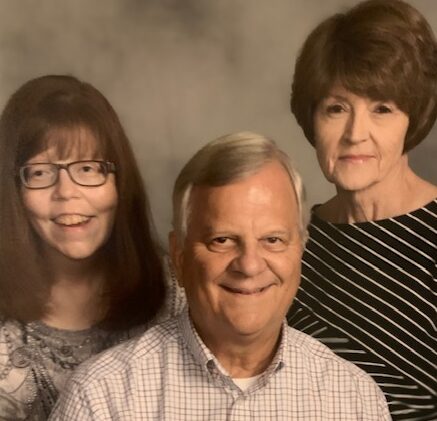
After several years of trying to start a family, doctors advised my husband Tom and I that fertility tests indicated it was possible but not probable that we would ever have children. How ecstatic we were when I became pregnant! My pregnancy was normal as was the delivery. When our daughter Lauren was born, she was declared a healthy 8 pound 2 ounce girl. Other than being overly fussy, the first few months of her life were normal.
When the time came for her to crawl, she didn’t. Other developmental milestones were missed. It was as if Lauren was developing on an 18 month calendar rather than a 12 month calendar. I began asking the pediatrician about her development and was told she had “mommyitis”. His assertion that I had spoiled my child so much as to affect her development devastated me. Although Lauren did not walk until she was 19 months old, her pediatrician still saw no reason to be alarmed. An exam by a neurologist resulted in the diagnosis of an immature nervous system. This was comforting since we were advised that as she grew, her problems would diminish.
When Lauren was 4 years old she began preschool and an astute teacher referred her to a physical therapist who conducted an assessment. She began going to occupational and physical therapy to address her motor deficits although the cause was still unknown. A chance visit to a different pediatrician resulted in a referral to LSU Medical Center in Shreveport. A pediatric neurologist began ordering tests to determine the cause of her developmental delays. Eighteen months later we were sitting in a geneticist office at LSUMC. He slid a single sheet of paper across the table and said, “Your daughter has 18p- syndrome and she will be dependent on you the rest of her life. I suggest you consider a supervised living environment for her.”
Here I sat with a child that is now 6 ½ years old – there had to be a mistake. The meager information he provided talked about mental retardation, cardiac abnormalities, and growth hormone deficiencies. These did not describe my child. For the next two years I was numb, angry, and then became depressed. Lauren was now not only in occupational and physical therapy, she had also started speech therapy. I was so guilt ridden that she did not have the benefits of early intervention, she began going to seven therapy sessions every week. This continued until she started first grade.
For the next twelve years, school consumed our lives. I saw so much potential in Lauren; she was such a hard worker. I was determined that she was going to get the maximum benefits from school and make up for lost time. She was placed in “special ed” classes until third grade when our local school system started their mainstreaming program. She benefited greatly from being around her peers, both academically and socially. Although she had to work 10 times harder than most other students, she passed the required standardized state tests and graduated from high school. She is now attending a local community college working on an associate degree and serving as a volunteer at LSU Medical Center. She hopes to begin work soon with assistance from Louisiana Rehabilitation Services.
I will close my story with the most poignant explanation I have found about what it is like to raise a special needs child. It has become my mantra.
Welcome to Holland
“I am often asked to describe the experience of raising a child with a disability – to try to help people who have not shared that unique experience to understand it, to imagine how it would feel. It’s like this…When you’re going to have a baby; it’s like planning a fabulous vacation trip to Italy. You buy a bunch of guidebooks and make your wonderful plans. The Coliseum. The Mihelangelo David. The gondolas of Venice. You may learn some handy phrases in Italian. It’s all very interesting.
After months of eager anticipation, the day finally arrives. You pack your bags and off you go. Several hours later, the plane lands. The stewardess comes in and says, “Welcome to Holland.”
“Holland?”, you say. “What do you mean, Holland? I signed up for Italy! I’m supposed to be in Italy, All my life I’ve dreamed of going to Italy.” But there’s been a change in the flight plan. They’ve landed in Holland and there you must stay. The important thing is that they haven’t taken you to a horrible, disgusting, filthy place, full of pestilence, famine and disease. It’s just a different place.
So you must go out and buy new guidebooks. And you must learn a whole new language. And you will meet a whole new group of people you would never have met. It’s just a different place. It’s slower paced than Italy, less flashy than Italy. But after you’ve been there for a while and you catch your breath, you look around, and you begin to notice that Holland has windmills. Holland has tulips. Holland even has Rembrandts.
But everyone you know is busy coming and going from Italy and they’re all bragging about what a wonderful time they had there. And for the rest of your life, you will say, “Yes, that’s where I was supposed to go. That’s what I had planned.”
Author: Emily Perl Kingsley
The most difficult part of raising a special needs child for me has been accepting Holland. For 6 ½ years I thought we were living in Italy. Once I realized we were in Holland, I fought acceptance of our fate and spent the next few years trying to find ways to change our destination. I used therapy and school in an attempt to overcome this diagnosis; I sought the fulfillment of the dreams for Tom and me and for Lauren of living out our original plans and expectations. I wanted Italy.
When I discovered the Registry about two years after Lauren was diagnosed, I finally received the first support and useful information about her syndrome since her birth 9 years earlier. I read the new guidebooks, I asked for advice and guidance from those who had lived in Holland for many years, and I began to accept this change in travel plans. I now see the inner beauty and strength my daughter possesses. She is always in a good mood, is kind to others, works hard to improve herself, and loves to read, travel and surf the web. She is truly special. How comforting to know we are not alone in Holland – there are many other special people to keep us company! I know Italy must be a wonderful experience; but, the joy and love received from and given to Lauren demonstrates what a wonderful place Holland can be.